
For high-end interior designers and property developers, the final 5% of a project is where the most significant friction occurs. You have spent months perfecting the spatial flow, managing structural contractors, and curating bespoke finishes. Yet, as the handover date looms, the creative joy of “aesthetic focus” is abruptly replaced by a logistical quagmire: the kitchen fit-out. It is a systemic drain on billable hours that rarely reflects the sophistication of the rest of the build.
Equipping a luxury kitchen to a “guest-ready” standard requires sourcing upwards of 75 individual items—everything from the weight of the flatware to the specific aesthetic of the small appliances. In a traditional procurement workflow, this forces high-value professionals into a tedious administrative role. Instead of focusing on design strategy, you are managing fragmented spreadsheets and tracking dozens of small shipments. This “scavenger hunt” across multiple retail shops doesn’t just exhaust your team; it actively erodes the profitability of the entire project.
The reality is that for a busy creative entrepreneur, this manual coordination is a silent margin killer. When a designer is forced to visit five different shops to curate basic kitchenware, the momentum of the project stalls. To maintain a competitive edge in a market where “turnkey” is the expected standard, the procurement process must move from a fragmented chore to a streamlined, professional solution.
The Myth of Luxury Retail Kitchenware
There is a persistent misconception that sourcing from high-end retail boutiques is the only way to guarantee quality for a luxury development. In reality, retail markups often mask a lack of true professional value. Retail environments are designed for the one-off consumer, not the bulk-need developer or the high-volume designer. By purchasing through traditional retail channels, professionals pay a significant premium for a storefront experience that adds zero value to the end client while tightening their own margins.
The most effective way to protect project profitability is to bypass the retail middleman entirely. Moving toward a factory-direct model allows designers to access premier brands without the retail “noise” or the inefficient markup.
“Most luxury kitchen wear is just overpriced retail garbage. Sourcing 75 plus items across five different shops isn’t design. It’s a scavenger hunt.”
The “Modular Assembly Line” vs. The August Shutdown
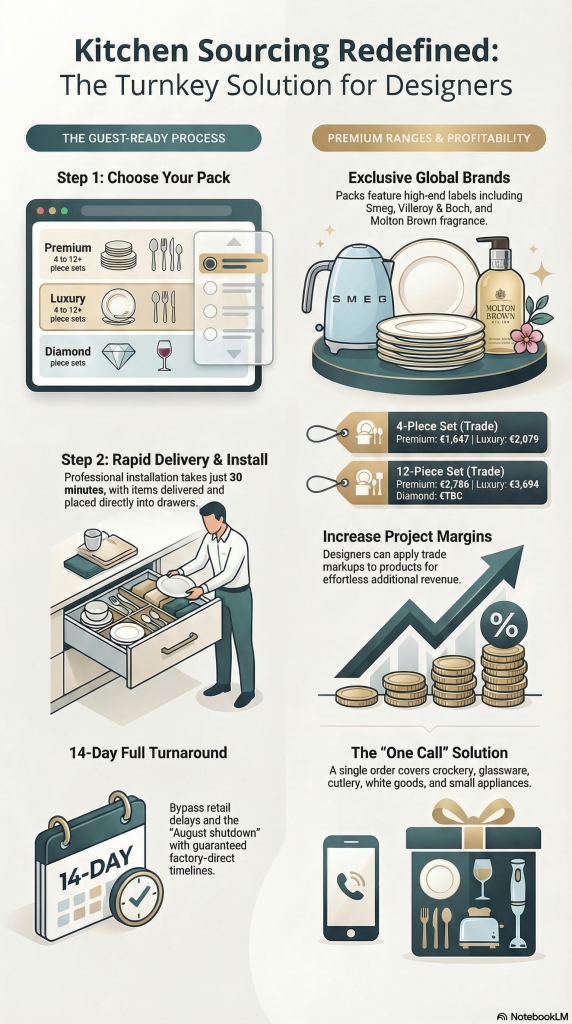
To solve the procurement bottleneck, leading firms are adopting a “modular assembly line” approach. This model treats kitchen equipping as a single, consolidated component of the build. By bypassing traditional retail logistics, projects can be fully equipped and installed in as little as 7 days, with a guaranteed 14-day maximum delivery window.
One of the most significant pain points for developers in the European market—particularly in Andalucia—is the traditional “August shutdown.” While the continent’s supply chain often freezes during the late summer, a factory-direct model ensures that manufacturing and delivery keep moving toward vital September completions. Perhaps the most significant game-changer is the installation itself: the transition from delivery to a fully staged, guest-ready kitchen takes only 30 minutes. This eliminates the hours usually spent unboxing individual items and managing the disposal of mounds of packaging.
Curated Excellence: From Premier Bone China to Smeg
Efficiency in this model does not require a compromise on quality. Sourcing is organized into distinct tiers—Premium, Luxury, and Diamond—specifically designed to align with project types, from high-end penthouses to sprawling Mediterranean villas. These packs leverage world-renowned brands and materials that meet the expectations of the most discerning clients.
What’s Included
- Crockery: Premier Bone China collections for a sophisticated dining experience.
- Designer Appliances: High-end white goods and small appliances, including kettles and toasters from brands like Smeg and Russell Hobbs.
- Professional Cutlery: 18% chrome, 10% nickel stainless steel for superior durability and a lasting mirror shine.
- Glassware: Fine crystal collections tailored for high-end entertaining.
- Cooking Essentials: Professional-grade pots, pans, and 75+ essential cooking utensils.
- Luxury Finishing Touches: Designer kitchen accessories and premium consumables such as Molton Brown products.
The Zero-Effort Profit Center
The most compelling argument for a professional sourcing model is the financial leverage it provides. By accessing factory-direct trade pricing, designers and developers secure significant discounts compared to retail costs, allowing them to add a healthy markup while still providing a “done-for-you” service that adds immense value to the client.
| Pack Type | Set Size | Trade Pricing (Excl. IVA) | Retail Pricing |
| Premium Pack | 4 Piece | €1,647 | €2,141 |
| 6 Piece | €1,934 | €2,514 | |
| 8 Piece | €2,221 | €2,888 | |
| 12 Piece | €2,786 | €3,622 | |
| Luxury Pack | 4 Piece | €2,079 | €3,551 |
| 6 Piece | €2,777 | €4,102 | |
| 8 Piece | €3,236 | €4,698 | |
| 12 Piece | €3,694 | €5,774 |
Note: For estate-level projects, the Diamond Pack represents the pinnacle of the service, designed specifically for large-scale villas.
Guest-Ready in Seven Days
The ultimate goal of any development is a property that is ready for immediate use. This streamlined model ensures the home is fully equipped and completely “trash-free”—meaning all boxes and packing materials are removed during the installation.
Industry leaders like Emma R. from Sol Interiors SL have described the experience as “absolutely seamless,” noting that the “flawless” installation saved weeks of logistical coordination. Similarly, James T. from Okater Services SL highlights the service as a “game-changer” for his business, providing both a new revenue stream and more time for actual design. Social proof from established firms like Debbie P. Designs SL reinforces that this isn’t just a procurement shift; it’s a fundamental improvement to the project lifecycle.
Conclusion: The Future of Frictionless Design
The interior design industry is rapidly moving away from fragmented, “scavenger hunt” sourcing and toward “one call, one solution” models. As project timelines tighten and client expectations for turnkey delivery rise, the ability to outsource the logistical burden of kitchen equipping becomes a major competitive advantage.
Ask yourself: how much time and money is your firm currently losing to the logistics of toasters and cutlery versus the high-level design work your clients actually pay for?
To reclaim your time and expand your margins, consider a more direct path to procurement. You can explore the transition to a factory-direct model by booking a 15-minute consultation at kitchenpack.es.